If approvals drag, projects drag.
3D engineering animation makes complex ideas simple and fast. People see function, sequence, risk, and value in what they are buying.
Traditional technical drawings and 2D schematics speak to engineers, but they confuse the decision-makers who actually approve your projects. And every day spent in approval is a day your project timeline and budget suffer, and your competitors move faster.
So if you’re tired of delayed approvals and endless review rounds, you’re in the right place.
This blog shows how technical animation speeds approvals, where it fits in your project workflow, and how to choose the right partner for excellent 3D engineering animation!
Key-Takeaways
3D engineering animation simplifies complex designs into brilliant visuals, helping reviewers understand the function, safety, and workflow instantly of the technical/engineered product
Miscommunication and fragmented CAD data are major causes of delayed engineering project approvals; animation unifies every stakeholder around one reference.
Integrating animation during concept, FEED, and design reviews prevents rework, reveals clashes early, and accelerates sign-offs.
Partnering with experts in engineering animation for client approvals ensures technical accuracy, CAD integrity, and measurable approval-time reduction.
Choosing a partner with proven industry experience and flexible workflows drives faster approvals and smoother project delivery.
The Challenge: Why Engineering Projects Face Delayed Approvals
Project approvals don’t fall apart overnight; they suffer slowly under layers of miscommunication, complexity, and uncertainty.
In engineering environments, every discipline speaks a different language: design teams share CAD drawings, management reads executive summaries, and authorities demand safety clarity. Somewhere between these layers, meaning gets lost.
1. Visual Disconnect Between Design and Decision
Most engineering drawings are precise, but they aren’t intuitive.
A 2D plan can’t show how a pump connects to a manifold, how operators access a panel, or how maintenance crews move in confined spaces. When non-technical reviewers can’t visualise what’s being approved, they hesitate, and hesitation slows everything down.
Example: In a recent EPC project, a refinery expansion faced four months of review delay because the commissioning team couldn’t visualize the flow of new lines through existing structures. A short animation showing process routing and operator access resolved weeks of back-and-forth within a single review meeting.
2. Fragmented Communication Across Stakeholders
Engineering projects are never built by one team alone. Design consultants work in CAD, mechanical vendors share STEP files, architects send layouts in DWG, instrumentation teams mark up PDFs, and safety auditors rely on written checklists.
Each format tells a part of the story, but never the full picture.
By the time these fragments move across departments, the data has already evolved. Drawings are revised, models are updated, yet reviewers are still discussing older versions.
Emails multiply, mark-ups conflict, and meetings revolve around reconciling differences instead of making progress.
This complexity in communication is one of the biggest reasons for engineering project approvals. 3D engineering animation eliminates the same and merges CAD models, process flow, and safety logic into a single visual that every stakeholder, from design leads to regulators, can interpret the same way. Instead of scattered data, teams review one unified reference!
3. Incomplete Understanding of Safety and Compliance
Authorities often delay approvals because safety provisions or access zones are not clearly demonstrated. Written risk assessments and mark-ups don’t convey reality; they rely on interpretation.
Regulators want to see safe egress routes, operator access, lock-out points, and emergency controls. When they can’t, they push for rework or site verification.
4. Revisions Triggered by Late Discoveries
A single overlooked interference, a misrouted pipe, or a restricted access zone can lead to redesigns late in the cycle. Late discoveries are expensive: they don’t just delay approval, they disturb through fabrication, procurement, and site schedules.
When animations reveal real-world conflicts early, changes happen while designs are still digital, not physical(saving both time and capital).
Clarity is the foundation of every project approval. Build it through 3D engineering animation with Arise3D.
Get Started
How 3D Engineering Animation Fits Into the Approval Workflow?
1. Concept & Pre-FEED Stage: Gaining Early Buy-In
At the conceptual stage, ideas are still forming. Layouts exist in sketches or preliminary CAD. Yet this is when decision makers and clients decide whether a project moves forward.
Unfortunately, early design presentations often rely on static slides or technical markups that leave decision-makers guessing.
That’s where 3D engineering animation brings clarity.
Decision-makers can instantly grasp layout, scale, and feasibility, even before full engineering begins.
2. FEED & Detailed Design Reviews: Turning Complexity into Alignment
The Front-End Engineering Design (FEED) phase generates the bulk of technical documentation: P&IDs, equipment lists, and access diagrams. Each review meeting can become a maze of markups, interpretations, and comments that drag on.
Integrating 3D engineering animation solutions at this stage changes how reviews happen.
Show how pipe racks route through modules.
Visualise operator access during maintenance.
Simulate component replacements to verify serviceability.
Display clearances around critical rotating equipment.
Every animation we produce goes through internal review by mechanical and process engineers. Scenes are verified against your actual CAD and vendor data before rendering.
3. Authority and Investor Briefs: Reducing Risk Perception
Once design stabilizes, the focus shifts to regulatory and financial approvals.
Here, the audience includes regulators, safety boards, and investors who may not understand engineering drawings but control project timelines and funding.
Engineering animation for client approvals simplifies these high-stakes presentations. It visualises safeguards, emergency procedures, and environmental measures in motion, helping non-technical stakeholders understand that every risk is managed.
Regulators can see egress paths, containment zones, and fire-safe areas.
Investors can visualise plant throughput and infrastructure readiness.
Safety teams can verify compliance in real time instead of scanning 2D layouts.
4. Construction & Commissioning
Use the same animation (or portions of it) for method statements, safety inductions, and vendor briefs.
You didn’t waste effort on something that’s only useful during planning.
How 3D Engineering Animation Speeds Up Project Approvals
1. Converting Engineering Data into Shared Understanding
Every department sees a project through its own lens. Design focuses on geometry, HSE on safety zones, QA on clearances, and project control on schedule impact. Static drawings rarely serve them all.
A 3D engineering animation solution converts technical depth into a form every discipline can interpret at once.
2. Clarifying Cross-Discipline Interfaces
Most approval loops slow down at interfaces where piping meets structure, or instrumentation overlaps with mechanical assemblies. Each department checks its own drawing, but few can picture how their work collides with others.
3D engineering animation reveals these interactions instantly.
3. Reducing Iterations in Review Cycles
Technical drawing can circulate through five approval levels before it’s cleared. Each round adds comments, revisions, and re-issuance. By using engineering animation for client approvals, reviewers can validate design logic visually in the first round itself.
The mechanical lead confirms maintenance access.
The safety officer sees egress and lock-out spacing.
The client engineer validates operability.
4. Strengthening Confidence Across the Approval Chain
Senior managers and client reviewers don’t need visuals; they need confidence that the design works.
A well-structured 3D engineering animation demonstrates functional logic: equipment motion, operator workflow, and safety integration. Seeing the process unfold assures reviewers that every design decision is justified.
5. Making Knowledge Transfer Smooth
Once a design is approved, the same animation becomes a reference for commissioning, training, and vendor coordination.
Because it was validated during approvals, it remains the most trusted representation of the design.
That continuity keeps communication consistent across the entire project timeline!
Real-World Examples of Faster Approvals Through 3D Animation
CASE 1 – Robotic Palletizer 3D Animation
This 3D animation demonstrates a robotic palletizing system, one of the core processes in modern industrial automation.
It visually explains how boxes are automatically picked, transported, and stacked onto pallets using high-robotic arms and conveyors.
The video begins with a conveyor line feeding uniform boxes into the palletizing zone. Each box moves in a timed sequence, guided by sensors and belt alignment. As the box reaches the pickup point, a multi-axis robotic arm positions itself, grips the box with a vacuum or mechanical gripper, and lifts it from the conveyor.
The robot then performs a smooth transfer to the pallet stacking station, where it places the box with calculated precision.
Each layer is arranged in a grid pattern to ensure structural stability and space efficiency. The cycle repeats as the pallet is filled layer by layer, representing an efficient, repetitive workflow with consistent accuracy and speed.
CASE 2 – Sludge Dehydrator with 360 Degree Rotation
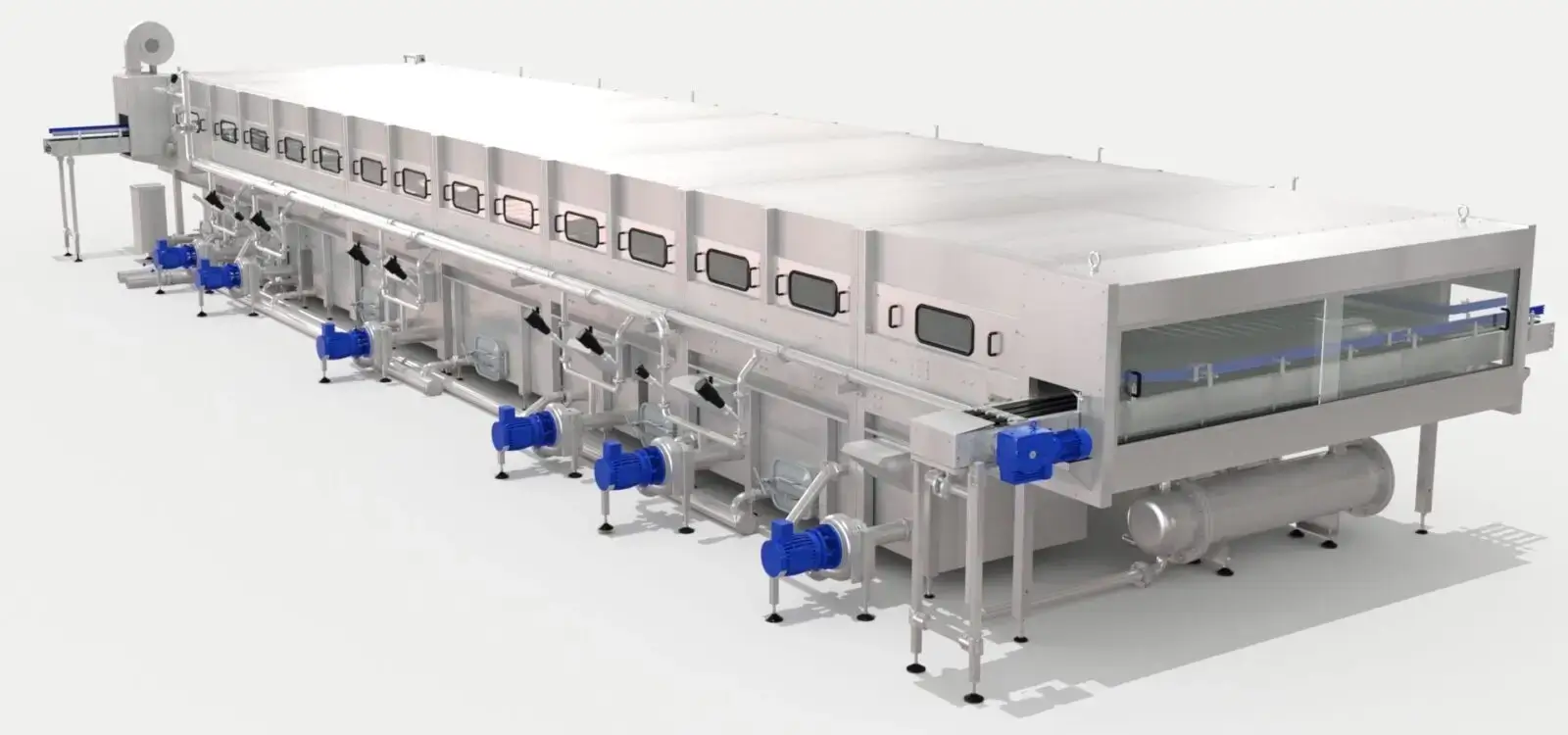
This 360-degree industrial animation lets you explore a sludge dehydrator from all sides so that you can easily inspect the feed inlet, processing chamber/drum or screw zone, filtrate drains/piping, motor gearbox drive, support frame, access hatches, and the cake discharge line.
The view helps you understand layout, clearances, and maintenance points at a glance.
Choosing the Right 3D Engineering Animation Partner
1. Engineering expertise, not just animation skill
Generic animation studios create beautiful visuals, but they don’t understand engineering constraints. They approximate. They stylize. They prioritize aesthetic appeal over technical accuracy.
Look for a partner who :
Work directly from CAD files (STEP, IGES, SolidWorks, etc.) without requiring artistic remodelling.
Understand engineering tolerances, clearances, and mechanical relationships.
Have experience in your specific industry.
Can discuss technical requirements intelligently with your engineering team.
Demonstrate portfolio work that shows engineering complexity.
2. Industry-specific experience that matches your application
Industrial animation requirements vary greatly by industry. Animating a chemical process plant requires different expertise than animating an automated assembly line or an oil & gas extraction system.
Industry-specific experience matters because:
Different industries have different approval stakeholder types.
Regulatory requirements vary by industry.
Technical complexity and visualization priorities differ.
Common approval obstacles vary by application.
A partner experienced in your industry understands what your stakeholders need to see and how to present engineering information for maximum approval impact.
3. Collaborative process that integrates with your engineering workflow
Your animation partner should fit into your existing project process, not require you to adapt your workflow to theirs.
Look for partners who:
Accept standard CAD file formats without requiring special conversions.
Work iteratively with your engineering team to ensure technical accuracy.
Provide review checkpoints so you can verify correctness before final animation.
Deliver on timelines that align with your project approval schedule.
Communicate clearly about technical requirements and animation capabilities.
4. Flexibility to support different approval needs
Your animation partner should offer flexible engagement models:
A) Comprehensive full-system animations for major project approvals
B) Focused animations addressing specific technical questions or concerns
C) Supplemental animation updates when design changes occur
D) Multiple animation versions showing different design options for stakeholder comparison
E) Rapid-turnaround animations when approval timelines are compressed
Flexibility also means format options. Stakeholder presentations may require high-resolution video files. Remote reviews may need compressed formats suitable for email distribution. Interactive demonstrations may benefit from controllable 3D viewers. Your partner should deliver appropriate formats for your specific approval context.
5. Proven track record of approval success
The ultimate validation of an animation partner is results. Do their animations actually accelerate approvals? Can they demonstrate measurable project timeline improvements?
Ask prospective partners:
A) For client references from similar engineering projects
B) About the typical approval timeline reductions they’ve delivered
C) For examples of delayed approvals that their animation rescued
D) How their animation addressed specific stakeholder concerns
Engineering animation specialists will provide examples and client testimonials demonstrating approval acceleration. Be doubtful of partners who talk about animation quality without discussing approval results.
FAQ’s
1) How can 3D engineering animation speed up project approvals?
3D engineering animation helps accelerate approvals by offering a clear, accurate, and intuitive visual of complex designs. It quickly resolves confusion and streamlines feedback, allowing stakeholders to get the project’s scope and function much faster than with static images/ technical drawings or 2D animation.
2) Why do companies use 3D animation during the project approval process?
Companies use 3D animation because it enhances clarity and fosters stakeholder commitment, particularly among non-technical decision-makers. It reduces misunderstandings and the need for long explanations, making it easier to show safety procedures or operational steps.
3) What industries benefit most from using 3D engineering animation for approvals?
Industries like Petrochemical, Oil & Gas, Manufacturing, etc, see the biggest benefits. These sectors have complex, large-scale projects where visualizing the final product is critical for safety and planning approvals.
4) Can 3D animation replace traditional technical drawings for presentations?
While 3D animation can’t fully replace the legal requirement for technical drawings, it improves them for presentations. The animation turns the drawing data into an easily understood, visual story that is highly effective and engaging for a wider audience.
5) How does 3D engineering animation improve communication with clients?
3D engineering animation improves client communication by creating a shared understanding of the project’s goals. Clients can see the final result, give accurate feedback based on the visuals, and feel more confident in the design, leading to higher satisfaction.
6) Does using 3D animation reduce project costs?
Yes, 3D animation can lower project costs by identifying possible design defects, conflicts, or safety risks before any physical work starts. Fixing these problems virtually saves money and avoids expensive rework and delays on the actual site.
7) How early should 3D animation be introduced in a project?
It’s best to introduce 3D animation early in the design phase. Using it to visualize initial concepts helps validate the design, confirm stakeholder agreement, and even help in engineering review. This early start maximizes its impact on efficiency.
8) Can 3D animation help with investor or government authority approvals?
Absolutely. 3D animation is an important tool for both investor pitches and securing government permits. It offers strong visual proof of project success, regulatory compliance, and community impact, building a clear, professional case for funding and approval.
Conclusion
Arise3D is a specialized technical animation studio serving the engineering industries for the past so many years.
Internal approvals slow when drawings demand interpretation. 3D engineering animation accelerates them by creating a shared, verified understanding across every review layer — design, safety, quality, and client side.
At Arise3D, every animation is engineered from CAD, reviewed by specialists, and structured for decision-making and the outcome? Shorter review cycles, fewer re-issues, and approvals that move at the speed of clarity. So, get in touch with our experts today!